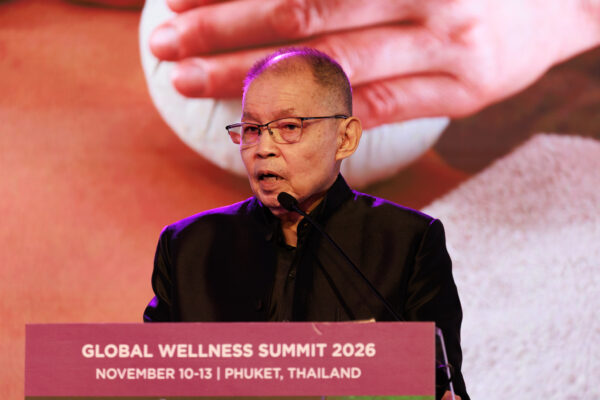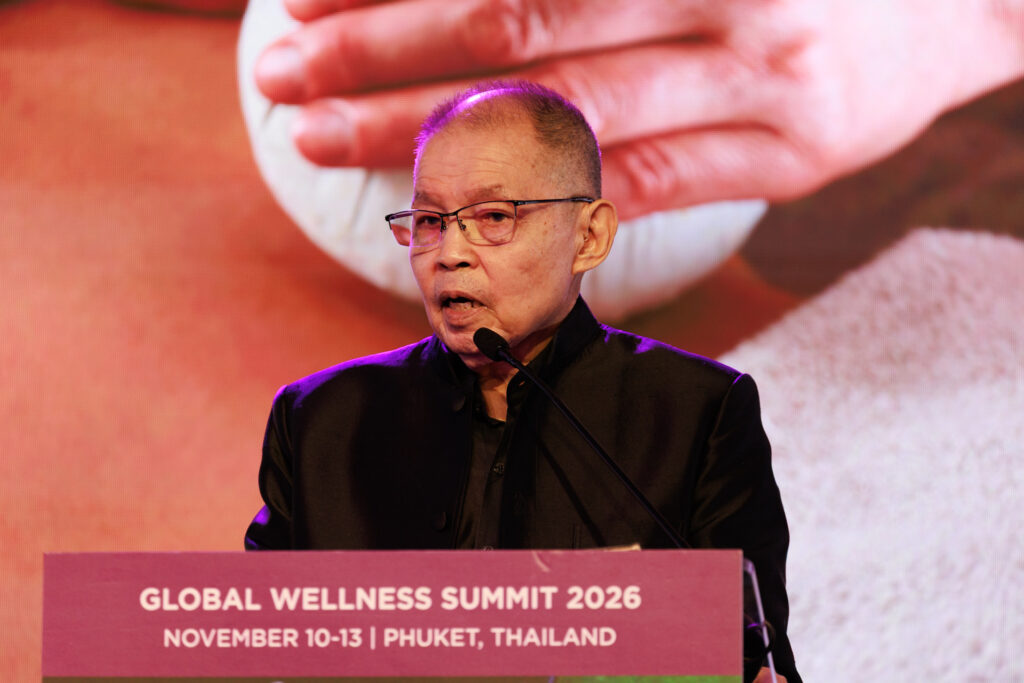
Wellness leader Krip Rojanastien challenges the industry to look beyond technology and measurement, advocating a future built on personal understanding, balance and the integration of ancient wisdom with modern science.
Thailand, 18th November 2026: At the Global Wellness Summit 2026 in Phuket, Thailand, Krip Rojanastien, Chairman and CEO of multi award-winning Chiva-Som International Health Resorts, delivered a keynote address challenging the global wellness industry to reconsider how it measures progress and approaches the increasingly important role of preventive health.
Entitled ‘Can a Wellness Destination Keep Its Soul as It Scales?’, the address explored a fundamental question facing the rapidly expanding wellness sector: how can the industry extend its reach and embrace scientific and technological advances without losing the human understanding, individual attention and quality of care that make wellness meaningful?
Speaking under the keynote title ‘Beyond Precision: Understanding, Balance, Personalisation’, Krip argued that while advances in diagnostics, wearable technology, genomics and artificial intelligence are transforming our understanding of the human body, knowledge alone is not enough to create lasting improvements in health.
“The future of wellness does not depend on how much more we can measure. It depends on how much better we become at helping people understand themselves,” he observed.
He highlighted the growing global burden of non-communicable diseases, arguing that prevention must take a leading role in healthcare to help tackle the world’s significant challenges. With healthcare systems facing mounting economic pressures, investment in preventive health and the promotion of sustainable lifestyle changes are increasingly essential.
Effective prevention requires more than sophisticated technology and data. It demands an understanding of the individual: their habits, environment, relationships, emotional well-being and response to stress. At Chiva-Som, this philosophy informs an approach to wellness that begins with listening, observation and understanding the person, rather than focusing solely on medical measurements or diagnoses.
A central theme of the address was the relevance of Thai Traditional Medicine and its contribution to contemporary wellness. Rather than positioning traditional practices in opposition to modern science, Krip advocated bringing the two together, recognising the complementary insights each can offer.
Drawing parallels with Traditional Chinese Medicine, Ayurveda and other longstanding healing philosophies – including the Traditional Arabic and Islamic Medicine that is the cornerstone of programmes at a Chiva-Som’s property in Qatar – Zulal Wellness Resort by Chiva-Som.
He also explained how Thai Traditional Medicine views health through the balance of four elements: Earth, Water, Wind and Fire, which together influence harmony within the mind, body and spirit.
This philosophy also resonates with the Buddhist concept of the Middle Way, which encourages moderation and balance rather than extremes. In practical terms, well-being is not about doing everything perfectly, but understanding when to push and when to pause, when to challenge the body and when to allow it to recover.
Krip also challenged the growing tendency to divide wellness into separate, measurable categories, reminding delegates that physical health, mental well-being and behaviour are intrinsically connected. Sleep influences concentration, stress affects digestion, and physical activity impacts mood. Genuine wellness, he argued, must address the whole person and the environment in which they live.
Personalisation, therefore, must go beyond tailoring programmes to individual biomarkers. Two people may present with remarkably similar measurements yet require entirely different approaches: one may need encouragement to slow down, while another needs the confidence to become more active. Understanding these differences is essential to achieving meaningful and lasting change.
“Expertise matters, but lasting change happens when understanding becomes confidence and confidence becomes action,” he said. The focus needs to shift from simply being told what to do to understanding WHY it matters and how it can make a difference.
For Chiva-Som, these principles are fundamental to its philosophy and long-standing commitment to quality of care over scale. As the wellness industry continues to grow, Krip cautioned against allowing standardised systems, protocols and technologies to take precedence over individual needs.
“Consistency is essential. Interchangeability is not,” he stated, stressing that systems should protect standards without becoming so rigid that they prevent practitioners from recognising the individual. A protocol can guide care, but it cannot replace judgement, empathy or the ability to listen.
Krip further called for a future in which ancient wisdom and modern science work together with greater understanding and purpose. He emphasised the need for wellness to be embedded in our culture from a young age, educating young minds while they are fresh and open to learning, and encouraging conversations around healthy living at school and home. The ultimate objective, he argued, should not simply be to extend lifespan, but to enable people to flourish; in simple terms, not simply adding years to life, but adding life to years.
His message reinforced Chiva-Som’s belief that the future of wellness lies in combining scientific advancement with a deeply human approach – empowering individuals to understand themselves, make informed choices and embrace healthier, more balanced lives.
He highlighted the importance of community, human connection and environmental sustainability, arguing that the future of wellness must extend beyond individual health to encompass the well-being of the planet and local communities. Healthy habits, access to nutritious locally produced food, meaningful relationships, physical activity and time spent in pristine natural environments all contribute to healthier and longer lives.
Concluding his address, Krip brought these thoughts together with a reminder of wellness as a shared global responsibility: “The world needs wellness as much as it needs peace and prosperity. Let us give it our very best.”
View the video below: